Diamondback Moth
Description:
Immature stages – Eggs are small, flat-oval (0.44 mm long), yellow, and usually laid singly on leaves. Larvae are light to dark green, tapering slightly at both ends with four pairs of prolegs, with slightly darker head and scattered hairs. Ranges in size from about 1.3 mm when hatching to a length of 8.6 mm in the fourth instar. Wriggles rapidly when disturbed and may drop from plant by a silken thread.
Adult stages – grayish-brown, with narrow forewings, fringed hind wings, and pronounced antennae. Body length excluding antennae is about 6-9 mm with a wingspan of approximately double this when fully extended. When the wings come together as in resting position they tend to form a line of contiguous pale diamonds down the middle of the back, hence the name.
Biology:
Life Cycle – The moth mates in the evening and lays eggs singly or in loose groups attached to the foliage. Larvae hatch in 3-5 days and develop through 4 larval instars in about 11 days under warm temperature conditions as it feeds on the foliage. First instar larvae feed on just the underside of leaves causing a “windowpane” effect – the upper epidermis still intact. Four instar larvae spin cocoons attached to lower leaf surfaces or the stem. Moths emerge from cocoons in about a week. The entire life cycle under warm conditions is approximately 3 weeks.
Seasonal Distribution – In Georgia there are multiple generations per year, with generation time slowing considerably in the winter months. Traditionally numbers were very low in the winter, but in recent years, greater moth activity has been noted when temperatures are higher than normal in December and January.
Damage to Crop:
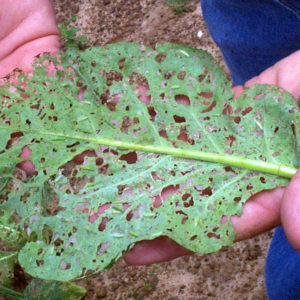
Larvae feed on foliage with early instars causing “windowpanes” or just the epidermis of the leaf left intact and larger larvae causing perforations in the leaf. Low populations under one larvae per 10 plants are not usually economically damaging early in the growing season, but should be controlled above this level. Cocoons are a source of insect contaminants late in the season and should be prevented three weeks before harvest.
Management:
Scout weekly to determine if the 0.1 larvae/plant threshold has been reached. Allow a 1-2-month production break in mid-summer to avoid building up populations between spring and fall (to reduce carryover of insecticide resistance). Rotate insecticides as this insect can develop high levels of resistance to many pesticides with their excessive use. Avoid excessive, season-long use of a single insecticide mode of action. Encourage beneficial insects by avoiding chemicals toxic to parasitoids like the wasp, Diadegama insulare.
David Riley and Alton “Stormy” Sparks Jr., Entomologists, University of Georgia, 2018